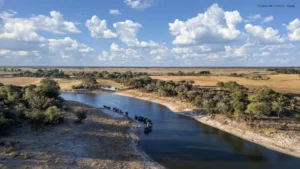
Vast, remote, and quietly reclaiming its place on Africa’s safari map, Luengue-Luiana National Park offers a rare glimpse into a wilderness still finding its rhythm again.
Covering more than 42,000 square kilometres in Angola’s southeast, the park forms a critical part of the Kavango-Zambezi Transfrontier Conservation Area (KAZA TFCA), one of the largest conservation landscapes in the world. Here, borders blur, and wildlife moves freely between Angola, Zambia, Botswana, Namibia, and Zimbabwe.
After years of isolation, Luengue-Luiana is undergoing a steady ecological recovery. Conservation partnerships are supporting the return of wildlife populations and restoring natural systems, allowing the park to re-emerge as a key stronghold for biodiversity in the region.
The landscape is both varied and dramatic – a mix of Kalahari sands, dense mopane woodland, and seasonal floodplains fed by the Cuando and Cuito Rivers. These waterways are lifelines, drawing in wildlife and shaping the rhythm of the park.
Elephants dominate the scene, moving through one of Africa’s largest transboundary populations. Predators such as lion, cheetah, and African wild dog are present, alongside antelope species including sable, roan, and the elusive sitatunga.
What truly sets Luengue-Luiana apart, however, is the experience. With minimal infrastructure and very few visitors, this is not a conventional safari destination. It is a place for those seeking something quieter, wilder, and less defined – where exploration takes precedence over predictability, and the scale of the landscape reminds you just how vast Africa still is.