
Pro guide Sibs Sibanda is a big man with a big reputation. He’s been in the bush since 1995 and is legendary for his ability to spot wildlife, for his expertise and deep knowledge of Zimbabwe’s wild lands. But still, Lorraine Kearney found a humble man, always willing to learn more, and share his knowledge.
In a country famed for the quality of its guides, there’s a handful who stand head and shoulders above the rest. These are guides who eat, sleep and breathe the bush, who can read an animal’s behaviour as fluently as others read a book, whose souls fly on the wind through the mopane trees, whose hearts pump savannah through their veins.
Sibahle Mgabeli Sibanda – known to all as Sibs – is one of these legends. Born in southern Zimbabwe, he earned his chops in Hwange, where he is based now, and he has guided in Mana Pools and the Kalahari Desert.
Sibs qualified as a Zimbabwean Professional Guide in 2000, and over the years has been Wilderness’ Best Guide in Zimbabwe as well as Zimbabwean Professional Guide of the Year. He trains young guides and is a Zimbabwe Professional Guides Association (ZPGA) examiner at national level.
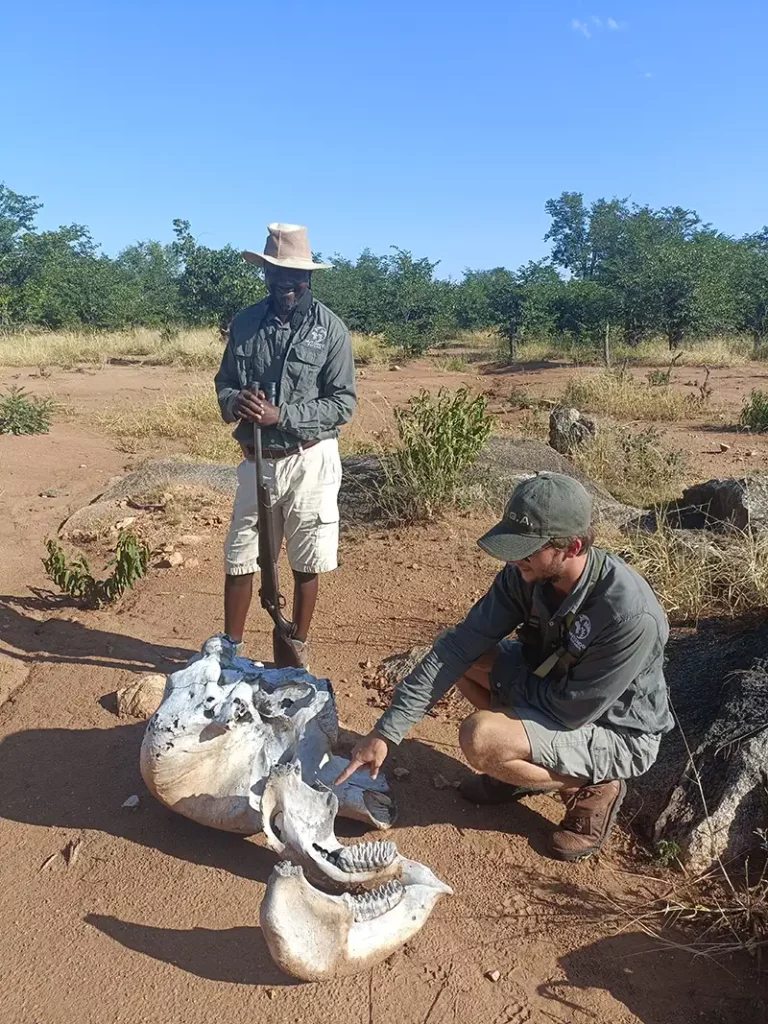
We’re having trouble communicating, Sibs in Hwange National Park and me in Cape Town, thanks to internet hassles. But no matter; I have walked and ate and talked with Sibs at Camp Chitubu, as he tutored a young guide, Daniel Woods.
In the game drive vehicle, with Sibs at the wheel, we got out of a tight spot between a rumbling bull elephant in musth and a herd of females without breaking a sweat. He’s a consummate guide, calm under pressure, and I have a measure of the man.
He tells me about becoming a guide – a sort of answering the call. “Visiting Hwange National Park where my brother was a school teacher lead me into this industry. After my O levels I started volunteering to babysit my brother’s house in the park during school holidays.
“First, I thought of becoming a ranger, but my brother introduced me to his friend who was a professional guide.”
At the time, most qualified guides in Zimbabwe were white. Sibs namechecks his mentors, among them Allan Eliot and Lionel Reynolds (“one of the finest guides ever to live in Zimbabwe”, he says).
He has an abiding memory of those early days of learning: “I was showing off when I was capturing a subadult lion with a net. I led the group as if I had done it before, proud of myself in front of the park’s general workers I grew up with. Now I was a learner guide!
“When the lion charged at us the guys dropped the net and ran. I was tangled up in the net with my high boots. The young lion growled in my feet and I screamed for help, but it wasn’t doing any harm. Lionel and the park’s boss shouted at the guys for running away.”
It was one of many lessons over the years. “The bush has taught me patience – listen, smell, torch and observe – as well as respect, discipline and care. You see how a weak animal submits to the dominant animal to avoid unnecessary fights; the leopard’s patience as a lonely hunter; painted wild dogs caring for the weak members of the family; young elephants following the bulls.”
I ask him about the most misunderstood animal. “Each guide has his own animal. For me, I think it’s the baboon. They cause so much damage in camps. All the blame goes to them, yet baboons are taught this behaviour by humans. Correct food disposal and not feeding them is best for them. But once they have been spoiled, they can be a big problem or be dangerous.
“You can benefit a lot by having a troop of relaxed baboons in your camp. When baboons are relaxed at the waterhole, all the animals are relaxed. They are usually the first ones to run away. They will warn you when predators are coming in.
“And they are very entertaining to watch when they are relaxed.”

Respect and humour are the two most important character traits, Sibs says. “I think instinct can be natural and at the same time it can be taught. Trainers need to teach their trainee guides to listen to their instincts.”
Speaking about those trainers, Zimbabwe is renowned for its tough guide training.
“Hwange as a starting point for guides is very good in that it has many animals and birds that are so easy to find. It has different terrains supporting different wildlife distribution.”
I have questions: How do you teach young guides to manage fear – their own and their guests’? What should a guide never sacrifice, even for a perfect sighting? How do you teach humility in a profession built on confidence?
Sibs has answers, borne out of more than three decades in the bush: “Fear should be managed by a good knowledge of wildlife and knowing what to do in dangerous situations. We discourage bravery, and safety for guests, self and wildlife should never be compromised.”
And stay humble. Humility can help you to learn more, even when you are confident in the subject. He tells of unknowingly guiding professionals: “One day I was explaining how different predators kill, later to discover that I had some scientists in the group who studied the bites of predators. I learned from them, too.”
Sibs has some concerns about the future. “There isn’t much excitement. Young people generally look at guiding like any other job and very few want to progress to full qualification.”
He has a few suggestions, among them is operators recommending their guides join the Zimbabwe Professional Guides Association. They should invite the association to train their guides and to get young guides to attend short courses organised by the association. Re-establishing inhouse and outsider training is another suggestion.
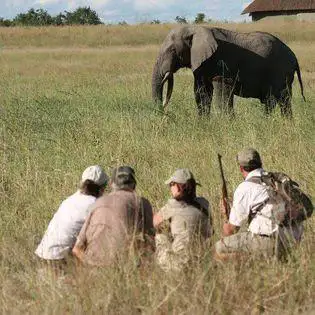
Modem technology is beneficial to guides and the industry, and should be embraced, but at heart, Sibs prefers the old way of guiding: guides’ job should be 100% focused on guests’ happiness, spending more time in the bush talking about nature rather than spending time in camps having cocktails and seven-course meals.
That said, he’s a great storyteller and can spin an entertaining yarn round the campfire. It’s clear, listening to him speak, that he loves the bush.
And if the bush could speak about you, Sibs, what do you hope it would say? “I hope it will say, ‘I love you too, Sibs.’”
