
By Heiko Dörgeloh
16 August 2026
There is a particular moment that happens when families travel well. It is not always the grandest sight or the carefully planned highlight of the itinerary. Sometimes it is a grandparent watching a child see the desert for the first time, a parent finally exhaling because everyone is safe and settled, or a teenager lingering at a viewpoint despite pretending not to be impressed.
Around a fire, beside the ocean, on a quiet road or beneath Namibia’s vast night sky, different generations briefly meet in the same place, both geographically and emotionally.
That is the real privilege of multigenerational family travel: creating time together while allowing each person to experience the journey in their own way.
Namibia makes this possible with unusual grace. Its openness, variety and unhurried pace give children room to be curious, parents the confidence to relax, and grandparents the time to take everything in.
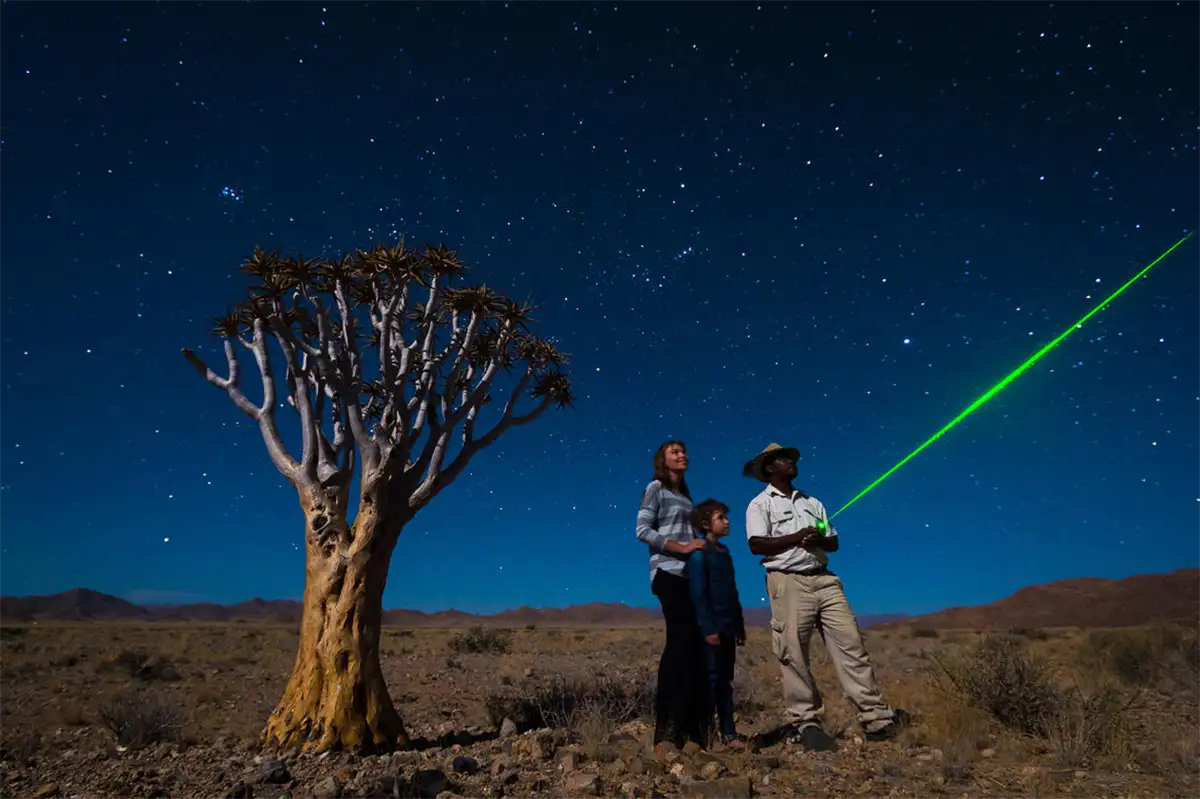
Anyone who has travelled with a child and a grandparent at the same time knows that family travel is rarely straightforward. One person wants to stop often while another wants to keep moving. Some need comfort and predictability; others want surprise and adventure. Teenagers value independence, younger children need flexibility, and parents often carry the invisible responsibility for everyone else’s safety, meals, moods, timing and expectations.
This is why multigenerational travel cannot be solved simply by adding extra beds, interleading rooms and a children’s menu. It needs to be designed with empathy. A well-planned family journey includes grandparents without rushing them, allows children to explore without creating chaos, gives teenagers enough freedom to feel fed, and reassures parents that the practical details have been considered.
The best journeys do not force every family member into the same pace. They create a flexible framework in which everyone can participate, rest, wander and reconnect.
Namibia is often introduced through its famous places: the Namib Desert, the Skeleton Coast, Damaraland, Etosha National Park, the Zambezi Region and the long gravel roads that run towards seemingly endless horizons. For families, however, its deeper gift is the way these contrasting environments naturally change the tempo of a journey.
In the Namib, enormous dunes and ancient geology turn ideas such as time, adaptation and survival into something children can see and touch. Damaraland offers rugged beauty, desert-adapted wildlife and opportunities to consider how people and animals live with scarcity. At Etosha, a family can settle beside a waterhole and watch nature unfold, allowing older and younger travellers to share the same wildlife encounter without constantly chasing the next sighting.
Further north-east, the Zambezi Region reveals another side of Namibia: greener, softer and shaped by rivers, birdlife and elephants. Along the Atlantic coast, desert meets ocean in a dramatic shift of mood, with marine encounters and cool air providing an entirely different family experience. Pelican Point Lodge, set on the remote Pelican Point peninsula near Walvis Bay, places guests between the Atlantic and the Namib, where seals, seabirds and the solitude of the coast create a memorable counterpoint to an inland journey.
Together, these places offer variety without the artificial pressure of constant entertainment. Each generation can find its own point of connection, whether through wildlife, history, geology, culture, photography or simply the pleasure of being somewhere completely different.

Namibia invites questions naturally. How do elephants survive in the desert? How old are the dunes? Who created the rock art? Why is the coastline littered with shipwreck stories? How do communities live alongside wildlife, and why does the night sky seem so much brighter here?
These questions do not feel like formal lessons because they arise from direct experience. A child learning about desert ecology while standing in the desert will remember it differently. A teenager hearing about conservation from someone who lives with its consequences may understand it more deeply. A grandparent watching younger generations engage with the natural world can pass on perspective, memory and curiosity.
Conservation-led and culturally respectful travel gives families more than photographs. It gives them shared reference points and stories that will be retold long after the journey ends.
Activities matter, of course. Safaris, dunes, marine encounters, cultural experiences, walks, boats, campfires and slow mornings all have their place. Yet the success of family travel usually depends on less visible decisions.
Families need realistic routing and honest advice about Namibia’s distances. They need accommodation that works for different ages and mobility levels, guides who can read the mood of a vehicle, comfortable transport, sensible meal times and room for rest. Medication, dietary requirements, private bathrooms, laundry, shaded pauses, communication and emergency planning may not sound romantic, but attending to them is what allows a journey to feel effortless.
When these details are handled well, families rarely notice them. That is precisely the point: everyone is free to be present rather than preoccupied. This quieter form of luxury is not defined only by beautiful rooms or private vehicles. It is found in thoughtful pacing, trusted support and the knowledge that each person has been considered.
Namibia also sits within a wider region where family journeys can unfold across more than one country. Travellers are often drawn to combinations not because they want to collect destinations, but because contrast makes a shared journey richer: desert and river, ocean and floodplain, solitude and concentrated wildlife.
Namibia brings scale, ancient geology, desert-adapted life and a powerful sense of stillness. Botswana’s waterways, Zimbabwe and Zambia’s wildlife and cultural depth, and the emerging journeys of Angola and Mozambique add different dimensions. Across the Africa’s Eden region, guides, lodges, pilots, conservation teams, community hosts and travel specialists work together to make movement between remote places feel seamless, safe and considered.
For About Africa Co, being part of this community reflects how travel in Southern Africa works at its best: through relationships between people who know the region, trust one another and understand the responsibility of caring for families far from home. Complex itineraries become manageable when there is genuine collaboration behind them.
Family today does not have a single shape. It may mean grandparents and grandchildren, a single parent and child, blended families, guardians, LGBTQ+ families, close friends who have become chosen family, or three generations gathering from different countries because time together has become precious.
Inclusive family travel begins by recognising this. No one should feel required to fit a narrow mould before they can belong. When planned with sensitivity, Namibia offers privacy, freedom and space for different kinds of families to arrive as they are. The aim is not to make everyone experience the country in the same way, but to create enough safety and ease for each person to find meaning within the journey.
For me, this subject is personal. As a single parent, I have tried to include my daughter in every journey I could, not because every trip was easy or because travel solves everything, but because it gave us something of our own. In our smaller father-and-daughter family, we learned to observe together: nature, people, distance, kindness, silence and the small moments that reveal what matters.
That experience changed the way I understand family travel. A successful journey is not measured only by where people sleep or what they see. It is measured by whether everyone feels considered: whether the slower traveller is never made to feel like a burden, the child is welcomed rather than tolerated, the teenager is heard, and the parent does not have to carry every worry alone.
This understanding shapes our work at About Africa Co and Pelican Point Lodge. We do not see multigenerational and family travel as categories to be packaged, but as deeply human experiences that must be planned with care. Namibia provides the setting; our role is to help create the conditions in which families, in whatever form they arrive, feel welcome, protected and free to make memories that belong only to them.
In the end, Namibia gives families more than a destination. It gives them a chapter they can carry together long after the journey has ended.
